
by Larry Hallock
It was a chair that could have come from a 1950s dining set—aqua blue tubular metal frame, vinyl cushion. Lashed to the top of our Toyota Land Cruiser, it was like the spotter’s seat on a safari vehicle. People from Addis Ababa to Yabelo, 355 miles to the south, might have wondered who was supposed to ride up there and exactly why....
Yabelo offers considerably more than the typically smaller villages of round mud huts and grass roofs in this part of southern Ethiopia. Its dirt streets are laid out in a grid and most of its homes of stick-and-mud construction are rectangular and have corrugated metal roofs. Yabelo even has a bank that’s about the size of a four-car garage and has several employees: one to operate a manual typewriter, one to dispense cash and three to sign off on a simple transaction to change money—but only after the serial number of each $20 bill has been recorded in triplicate carbon copy. Yes, carbon paper.
The main drag, a dirt street the equivalent of several block long, is lined with small, open-front shops that look more like shacks by American standards. They have dirt floors, sometimes covered with mats, and most are illuminated only by daylight. Some sport flimsy electrical cords running to bare light bulbs that use generated electrical power whenever there is some.
These shops sell sugar, condiments, cloth, grain, incense, new and used clothing, basic pots and pans and so forth. Two shops display half a dozen rudimentary mannequins of painted plastic which hang from a wire on a tree—as if hanged—like so many female outlaws brought to justice wearing their finest. Shades of the regretful Miss Otis….
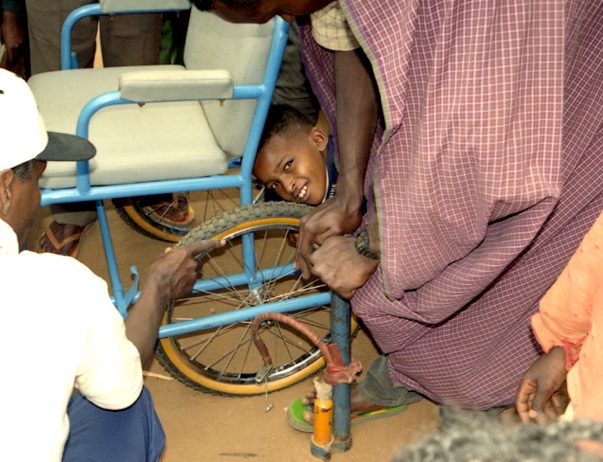
Kassahoun, our driver, stops in front of a shop where bicycles are repaired. (Oddly, there aren’t many bicycles in these parts.) We untie the chair on top of the car and lower it to the ground, along with some parts that go with it. A crowd of thirty or so gathers to watch as the parts are assembled—the seat, a floor, some wheels. An old tire pump that looks like it was salvaged from a junk yard falls apart in the hands of the shopkeeper. But he manages. While he inflates the tires, I turn to watch the colorful traffic: people, goats, sheep, cows, a camel here and there, and the occasional donkey-drawn rickshaw.
A large field nearby is the site of Yabelo’s weekly market. But that’s not today, the field is bare. Gazing across it, I happen to focus on two guys on a bicycle in the distance. As they come closer, I notice they’re grown men, not boys. One is pedaling, the other is riding sidesaddle. I don’t think this scene is particularly odd in a place where nearly everything that hits my eyes is unusual to me. The bicycle seems to be heading straight for me, and indeed comes to a stop right in front of me. Only the one who was pedaling gets off the bicycle. Dismounted, he picks up his friend in both arms and lifts him from the bicycle. Lifted down to the ground, the legs of the cyclist’s friend seem to fold away and out of sight, like the roof of a hardtop convertible. He appears to be standing from the waist.
The first man picks up his friend again and steps toward the crowd surrounding the wheelchair. The last bolt has just been tightened and the wrench set aside. The crowd parts, and the two friends move into the inner circle. The polio survivor is placed in the wheelchair and everyone cheers. The celebrity of the moment just grins like it’s the best day of his life. There are no speeches, no fanfare—no one signs for the delivery. Someone starts to push the chair, and the crowd parts again. I take pictures as the man moves back across the field in the direction from whence he came, on a different set of wheels.
The entire event seemed as choreographed and as perfectly timed as a wedding—and before we knew it, the revelers were left to mingle and talk about the weather.
________________________
Copyright © by Larry Hallock