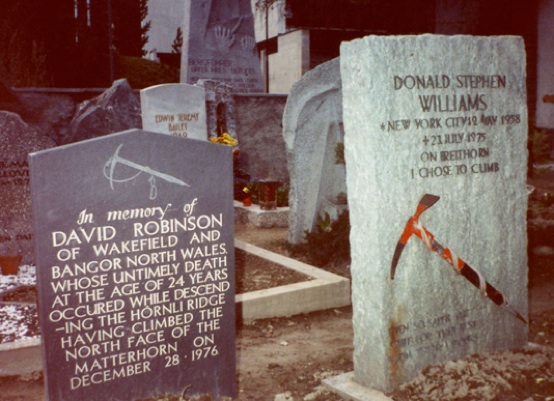
Photo: Larry Hallock of Chicago

But can I see it in the morning from Milan?

by Larry Hallock

    Far from the Kansas farm of my childhood is a place called Zermatt, a popular ski resort in the heart of the Alps. It is charmingly quaint—and expensive. It lies in the shadow of the Matterhorn, one of the world's great mountain peaks, known to some as the backdrop for Ricola cough drop commercials. Others know it as the formidable opponent of many who now lie under intricately carved tombstones in the heart of Zermatt. Narratives carved in granite tell of many a brave climber who lost to the Matterhorn's challenge. In Zermatt, journeys are celebrated. 

      I first met the Matterhorn in fourth grade. I’ve long forgotten the details of the story our teacher read, and the names of the characters. Hans and Heidi or some such. I think they frolicked in the grassy fields that caught sunlight only in the mornings, thanks to the Matterhorn. The mountain would age thirty-five more years before I would take my parents to Europe for their fiftieth wedding anniversary—and meet the Matterhorn in person. We would decide to squeeze Zermatt in, on our way to Milan, where Mother wanted to see da Vinci’s  Last Supper, a copy of which has decorated her kitchen wall since her wedding day. 

We rented a car in Luxembourg and drove to Switzerland first. Still hours away from Zermatt, we encountered an enormous landslide that had buried a section of the highway three days earlier, along with the adjacent river and much of the valley. Half a mountain had broken off, leaving everyone in the upscale resort stranded for a couple of days. We sat two hours before a flagman signaled westbound traffic’s turn to enter the makeshift one-lane maze of oversize rubble. On our own Disney ride, we maneuvered around heavy earth-moving equipment that looked like toys next to boulders bigger than they could budge. 
Well beyond the disaster area, our highway ran out. Traffic proceeds from that point only by train ferry. A train showed up as if scheduled just for us and a man in pin-stripe overalls and matching cap guided drivers up a ramp and onto the flatbed railroad cars. We stayed inside our vehicles as the train glided over rocky terrain that the government has for some reason not seen fit to pave. Half an hour later we drove off the train and onto the start of another highway. 
Eventually we parked among several hundred other cars in a lot three miles away from Zermatt and boarded a shuttle bus—private vehicles are not permitted to pollute the town’s charm.
Our bus dragged itself to the edge of Zermatt shortly before dusk. Its cargo ho-hummed their way off the bus and plodded lazily toward their expensive inns like they had a couple of weeks to spend. We had only a couple of hours, or only minutes if we wanted to catch the Matterhorn before her bedtime. We had to make it—our budget-sensitive schedule didn’t allow for an overnight in Zermatt. As though a lifetime plan were at stake, I speed-walked around the slowpokes, parents in tow. 
“It’s not going anywhere, is it?” Mother asked, as if seeking information. Of course I understood. She was tired—but the Matterhorn didn’t happen to be an old friend of hers. I just kept tugging, barely noticing Zermatt as I bored our way to its center as fast as Mother could manage to keep up. But why couldn’t I see the mountain already? Where was it?
Some people boarded the horse-drawn carriages that waited for the bus’s arrival. I flagged one of the glorified electric go-carts they use for taxis and paid the man to take us to the best viewing spot. He putted us up a hilly street past pubs and shops and restaurants, and dropped us by a crowd of twenty or thirty people staring at a dreary sky. Nice fog, I thought. Where’s the Matterhorn?
“Oh, she behaves like this in the evenings,” a Jewish-motherly voice says. “Early morning is the best time to see it. It’s always clear in the mornings. You can see it in the morning!”
But can I see it in the morning from Milan?
She feels so sorry for us. It is such a shame, she says. 
My parents aren’t willing to hang around for a mountain that doesn’t show. They say they want to visit the climbers’ graveyard. I should meet them there later. The woman watches them walk away.
Then, suddenly, as if deliberately contradicting the woman, the awesome Matterhorn satisfies my anticipation and makes an appearance. Beguilingly demure—as is her evening reputation—she plays to the crowd, teasing us relentlessly by dropping her foggy shroud now and then, just enough for an occasional glimpse. She knows how to sustain our attention, and she plays it to the hilt. 
Clouds of layered light dance breezily cheek to cheek with the Matterhorn’s classic form. It is a slow dance. Her image filters back to us through the misty veil as her partners leisurely sway about, high in the wind. She looks tall and regal.
I didn’t see all of her, but I saw her face, and that was enough. I imagined standing even closer, in places only climbers go, where silence is broken only by the exuberance of crocus.

I follow the smell of coffee to a nearby café, a clear-varnished pine chalet looking as crisp as the air feels, but considerably warmer inside.  There I can people-watch while keeping an eye on the sky that hides a mountain. I grab a stool, scoot up to a window and begin to notice Zermatt. The people are young and beautiful. They wear colorful sweaters. Leather coats. Designer clothes with labels on the outside. They laugh together, cheeks pink in the cold, ski gear dangling from their bodies like jewelry, their presence decorating the streets. Not a furrowed brow in sight. So this is where they take those Christmas card photos, I think to myself. Of course! And the pictures for winter clothing catalogs too.
I spread my hands over as much of the hot paper cup as I can. Rich coffee. For the rich. Clearly this is a frolicking place for the rich. And here I am among them, rich too. I have no slick skis over my shoulder, no cell phone on my belt. I can’t even afford to spend a night in this place. Yet I stare at the fog whisping around the Matterhorn’s crown and ponder my wealth.

My parents have covered half the cemetery when I find them. The tablets of dark granite that dot the rolling green appear polished to a mirror finish in the evening mist. They are embellished with relief images of the face of the mountain and, on some, the faces of its challengers. The stories in their chisled paragraphs make it clear that this ground is more than just a pretty little park nestled among touristy shops.
Mother squints at the next headstone—it is almost too dark to read now—and she takes the story like she takes tragedy on the evening news, feeling it nearly as her own. “Oooooh,” she moans, “he was only twenty-three. Ahhhh.”  
Dad takes it like he takes the evening news too, always already in the know. But for his farmer’s cover-alls, onlookers might think him our guide, standing by, patient and detached as we get emotional.
Everyone on the bus back to the parking lot is quiet—most because they are exhausted, we because of freshly lived tragedies of expeditions failed. We find our car, and as I drive out of the lot, the Matterhorn suddenly seems as far away as ever. I’m still wondering if Zermatt really happened, when Dad asks if I know where I’m going.


Our ambitious plan was to continue to Milan that evening, although a range of the Swiss-Italian Alps stood between us and Italy. In charting our route, I spotted a long straight line on the map which represented a welcome wonder of modern technology that would save us a lot of time. An enormous tunnel, miles in length, would get us speedily—and literally—through the mountains. 
Local maps with foreign spellings can be a challenge. With one in hand, I stopped at a roadside market and approached a bearded, Santa-sized man in a red shirt who was closing the place down for the night. He took the map from my hand. 
“Lost!” he announced, as opposed to asked, in his German accent. “Ho ho ho!” He laughed as he handed the map back to me and dropped a heavy arm across my shoulders. He pointed me toward a tree across the yard. “Friend, take map and go to tree. Shake tree very hard, look at map to see where tree moves. Then you see where you are!”
“Ho ho ho, come back!” he continued, as if I had actually headed for the tree. “Where you want to go?” The man confirmed we were headed toward “big tunnel.” 
An hour later, road signs to Milan began to appear, so I was relieved to follow those. I didn't know they were the old signs to Milan and that they pointed to the old overland pass, not the tunnel.
By the time I realized we'd never see that tunnel, the night was well underway and we were already high in the mountains, committed to the longer route. But as we surveyed what we had traded the walls of a high-tech tunnel for, we were amazed at the extent to which we had traded up. We had entered some of the world’s most spectacular scenery, all of it glistening in the mystical light of a serendipitous full moon. 
Typical of Europe, the Alps reflect a certain architectural economy of space. They are bunched up, squeezed together, denser than other mountain ranges which by comparison tend to be more like sprawling ranch houses than the castle-like Alps with their towering spires and turrets. The Alps are enchanted.
Some Alpine roads are but tiny ribbons of blacktop that seem barely attached to the edges of drop-offs. The one we were on turned often and unpredictably, but our rented Peugeot traced the white lines infallibly—not merely as though our lives depended on it. Mighty peaks adorned with crystal glaciers paraded by, like beauties on a catwalk, showing off in raggedy and smooth, tree covered and ice covered, towering both above us and below—illuminated by magic.
Around one bend was an enormous snow bank that had been plowed into a cutaway in the trees on the left side of the road. Anyone who has ever tried to buy ice in Europe will understand why we had to stop, even at the midnight hour, to take advantage of such a find. Dad opened the trunk and began packing our ice chest with snow—he would know the only way to do it exactly right. Mother stayed in the car with the heater on as I wandered up the hilly road until the car and the sound of its engine faded behind me. The road was dead, like a silent leftover leading to some long-abandoned gold mine. 
I stood as close as I dared to the edge of the rugged rim of a gigantic valley thousands of feet below and miles wide. Massive peaks formed a moonlit circle around this immense basin. I suddenly felt profoundly alone and small. I was but a grain of sand on the massif, subject to the indifference of nature. The darkness under the snow-laden branches of spruce that clung to the wall below me seemed thick, impervious to the moon. An absolute silence certified my journey from reality—I was light-years removed from civilization. 
I didn't trust the deceptive silence. There had to be some kind of life out there, but I feared to think what. A chilly breeze brushed the trees, but whatever else might have tread, pounced, flown or crawled did it noiselessly.  Even the cold of snow and ice waited to stalk in silence, should one fall or stray into its territory. I guarded my steps more carefully.
Then, on that deserted mountain road in the middle of the night, a million miles from nowhere, music broke the spell. An accordion played! As I walked farther up the road toward the sound, the top of an old log house rose into view. It was a tavern—out there in nature’s no-man’s land, tucked into the edge of a forest on the other side of the road that edged the treacherous drop-off. Its windows were aglow and polkas announced the obvious: there was life. 
How warm and inviting the sight, how welcome amid such an assembly of cold might!  I saw no cars and wondered where the people had come from. Did they walk? Was a village close by? Was there a settlement so hidden that no lights gave it away, so rustic that no modern city sounds ruffled the air?  I was nearly convinced the unlikely tavern was a mirage. 
I didn't go inside. Seeing actual faces, or a parking blight on the other side, would have spoiled the moment. I took my time in the chilly breeze at the edge of the road and pondered how many worlds separated me from the foreign-speaking revelers in the tavern, and from my parents waiting in the car down the hill—Dad feeling fully in control and dozing in the back seat by now—Mom in the passenger’s seat wondering what her middle son was up to now, and what they would do if he never came back.
I snuggled deeper into my coat and surveyed the bottomless chasm and the distant surround of stone, trees and glaciers gleaming in the bluish glow. While I stood at the brink of total isolation, distant polkas weaved a fragile thread around me, as if connecting me to life itself. Only that tiny thread seemed to make the difference at that moment—the difference it took to hold me back, to keep me from falling literally into that ultimate oneness with nature, which can oddly seem inviting at times. I sensed a tension between my oneness with humanity—that which makes us passionate—and my oneness with the awe, the treacherousness, the silence that is nature—that which keeps us humble.
_______________________
Copyright © 1996 by Larry Hallockhttp://www.peakware.com/photos.html?pk=1089shapeimage_2_link_0

A Fragile Thread

Writings   —   Slideshows   —   Photography   —   Rehabbing