
When the Biblical Research Institute of the General Conference of Seventh-day Adventists publishes a paper, it means something. The institute's approval is like an imprimatur. So when the institute decided to publish Ronald Springett's paper on homosexuality, many hoped it would be a turning point in Adventist thinking, demonstrating a clear and honest understanding of homosexuals and homosexuality. But it wasn't.
Springett's 173-page book is divided into seven chapters. The first purports to tell what homosexuality is, the last summarizes the author's conclusions. The substantive middle portion of the book is a detailed, scholarly discussion of references to homosexual acts in ancient history and in biblical texts.
Springett often acknowledges the difficulty of determining the meanings of texts, and is candid about sometimes only "leaning" toward his preferred view because it is consistent with his basic point of view, and because it "cannot be entirely ruled out." His coverage of the Sodom story is one example of this ambiguity. Although Springett holds that homosexuality was part of the Sodom sin problem, he admits that "there is no explicit mention of homosexuality here...."
Springett, in discussing the causes of homosexuality, makes it clear that no one knows what determines sexual orientation, and that there is a growing preponderance of evidence that biological factors play a major role. Regarding change of orientation, the author refreshingly avoids parroting the false claims of "change" programs, noting that those claims are challenged, and that the view that change is impossible "has been in the ascendancy for some time now." He distinguishes between change of orientation and change of behavior, and acknowledges that "the homosexual should not be led to believe that all desire for and temptation toward same-sex acts will be quickly removed."
But this modest progress toward understanding the permanence of sexual orientation is tarnished by cliché rebuttals, such as equating all homosexual expression with heterosexual lust, and summarizing his insights with the comment that "we believe that the Lord can change what the world cannot." Instead of offering any evidence that the Lord has ever chosen to grant an orientational change, Springett merely argues that the Lord could—a point that no one questions.
In spite of Springett's distinction between orientation and behavior, and the arguments he reports on the improbability of change, he never quite boils the matter down to a serious discussion of the basic question—does God require Christian gays, in permanent, monogamous relationships, to be celibate, or not to have even platonic relationships? Even in 1989, it seems this much clarity of focus is too much to ask of many Christian writers, Ronald Springett among, them.
Unwarranted Conclusions
Springett offers no original thought to challenge Adventism's thinking in regard to homosexuality, and predictably picks his conclusion from the only two traditionally safe choices: all black or all white. And black it is. Springett concludes that condoning homosexual activity would require the church' s view of scriptural inspiration "to undergo such a radical, liberalizing change that the fundamental teachings of the church would be left without foundation," the consequences of which "would be a giant step toward repaganization of the church.'' Fundamentalism reigns.
The extreme and certain nature of this conclusion is inconsistent with the author's many acknowledgments of scriptural ambiguity. Suddenly the difficult texts Springett took a hundred pages to discuss have "plain meaning." The author states that "numerous questions remain to be answered" and emphasizes that "if the church is to gain a clear picture of homosexuals ... and how to relate to them, much consideration remains to be done beyond this [book]," which is just a "preliminary study." Yet his conclusions are anything but tentative!
Springett, after acknowledging that "Adventists have developed no universally consistent system of interpretation of Scripture," lists four principles of interpretation that are "widely held" in conservative Adventist circles, and the book "proceed[s] along these lines." But seven chapters later, the book's conclusion cheats thoughtful readers out of a discussion of all acceptable Adventist points of view, denying what the book's preface clearly implies: a perfectly legitimate, more moderate Adventist interpretation could result in very different conclusions.
Absurdities
The unpardonable sin of the book's introductory chapter is the author's answer to "What Do Homosexuals Do?" Springett begins by noting the "considerable mythology" and "misinformation propagated in popular culture," and continues by providing some of his own. Focusing on promiscuous genital activity, he details toilet sex, child molestation, "cruising," fellatio, anal sex, sadomasochism, "trade," et cetera, emphasizing his belief that the one most common social activity for gays is searching for a "one night stand."
Springett showcases the sexual behavior of certain male homosexuals in a large inner-city gay ghetto as his chief example of what homosexuals do, omitting reference to a multitude of gay and lesbian organizations that exist in all major cities, such as gay academic organizations and professional groups; gay community groups; gay government liaison groups, gay political organizations; gay coffee houses, writers' clubs and art and entertainment groups, AIDS organizations and projects; predominantly gay churches and synagogues, and gay religious organizations and support groups; legitimate gay publications; gay sports teams in tennis, swimming, racquetball, football, baseball, basketball, wrestling, bowling, and athletic events; gay choruses; and national gay advocacy groups—legal and political.2 Springett's assertion that sex with strangers is the most common social activity of homosexuals is challenged by the existence of such organizations, and by the fact that many gay and lesbian people socialize in largely heterosexual circles.
Absent from Springett's discussion of what homosexuals "do," in short, is anything that would make them look good.
Scholarship and Readability
Factually, the book errs, for one example, in stating that homosexual acts are currently "illegal by general United States standards." In fact, as the states continue to repeal antiquated laws, a growing majority of Americans now live in states where all forms of sexual activity between consenting adults, including homosexuals, are legal.3 [In 2003, in Lawrence v. Texas, the Supreme Court struck down all laws that criminalized sex between consenting adults.]
While the historical Sappho is discussed, lesbians are barely acknowledged in the book. Even granted that the term "homosexuals" includes women, the author repeatedly betrays himself as thinking only of men: his behavioral discussions are of male behaviors; he does not discuss how his theories of etiology (such as environment) apply to women; he does not address the Bible's virtual silence on female homosexual acts; and his momentary usage of the term "he/she" early in the book quickly reverts to "he" or "gays," a term often taken to denote males.
The book is so poorly organized, developed, and edited that one wonders how it cleared the Biblical Research Institute. The discussion of orientational change is introduced in the "Conclusions" chapter. Issues are discussed or ignored without apparent reason. The author doesn't tackle—or even list—the "moral and ethical questions" he says arise.
Many seek an understanding of loving monogamous gay and lesbian relationships and issues of celibacy—but Springett offers no substantive discussion of these. No one is arguing in favor of depraved, compulsive sexual activity—but Springett discusses it at length. If, as the author states, the book's purpose is to look at "pro-homophile" arguments, why does he focus on non-issues?
Editing problems range from the two dozen typographical errors listed on an insert, to problems regarding terminology. Springett defines "pervert," "invert," ''constitutional," "acquired," and "situational" homosexuals, then confuses readers with undefined terms such as "exclusive," "essential," "active," and "primary" homosexuals.
Numerous blanket assertions and over-generalizations of varying importance are made. ''Homosexuals,'' not just those in error, says Springett, "need to reconsider the scriptural passages.'" "Homosexuals in the Christian context need to study the Scriptures for themselves," he continues, as if many haven't spent their lives doing just that. Another example makes one suspect the author is simply writing off the top of his head: "Many homosexuals are convinced that increasingly permissive sexual attitudes in the church will in time lead to acceptance of their sexual behavior. Consequently, it is difficult for many Christian gays to understand why they are scapegoats for sexual sins in the church." The author cites no study to support these broad suppositions.
Other problems are more serious. The difference between orientation and behavior is not clear in Springett's own mind. He uses homosexuality and homosexual sex synonymously, as if a difference does not exist. The various Scriptures, for example, are often mentioned as referring to "homosexuality." In a study where the distinction is crucial, such carelessness is a major flaw.
Springett seems to pick and choose which scripture passages to interpret literally. Although he readily admits in reference to Leviticus 19:19,4 that "as to seeds and cloth, this text is difficult to interpret at best. We do not really know what is meant here." Some might wish that he and the church were a fraction as aware of their fallibility on the issue of homosexuality. Many would prefer that the church acknowledge honestly and courageously the true tenuousness of contrived "certainty" on issues that so directly affect people.
Conclusion
A review of this book must include a look at the church that commissioned it. One thing about the church seems apparent: it is afraid to know homosexuals. Knowing homosexuals means wrestling with the heart, struggling with compelling issues. Somehow the church has managed to reconcile a narrow view of inspiration, with science and the experience of human beings, in regard to farming, blended fabrics, slavery, women, divorce, and more. But its method is still to pick and choose on the basis of convenience, and that is apparently how Springett's paper—and only Springett's paper—got published.
Homosexuality in History and the Scriptures tiptoes closer to reality than many Adventist writings, but this meager advance and its perfunctory call for compassion hardly mitigate the book's faults. Pastors, teachers, parents, and young people seeking information will get little more than the same old genital caricatures and the same old proof-text certainty. For a meaningful discussion of issues that relate to real Christian people in the real world, Adventist readers will have to look to the presses of other Christian denominations.
NOTES AND REFERENCES
1 . The Biblical Research Institute had assigned a paper on the subject to ethics professor David Larson of Loma Linda University. When Larson was asked to enlarge the study and revise his paper, he declined to continue. His paper encouraged the church to empower congregations to deal with homosexuality case by case.
2. In Chicago, for example, directories list 16 gay and lesbian academic organizations; eight professional groups 32 community groups, including both women's and men's organizations; business/community associations; groups based on nationality, race, hobbies, et cetera; 17 gay and lesbian political organizations; 10 entertainment spots; 28 AIDS organizations and projects; 36 religious organizations/support groups, along with several predominantly gay churches and synagogues; six legitimate gay publications; more bowling teams than gay bars; and several gay choruses, one of which has won multiple grants from the National Foundation for the Arts.
3. Only five states have laws that single out homosexuals; 10 others criminalize certain sexual activities for everyone, including heterosexual couples. [Later note: all of these laws were subsequently struck down in 2003 as unconstitutional by the U.S. Supreme Court in Lawrence v. Texas.]
4. Revised Standard Version, as quoted by author.
_____________________________
Larry Hallock received his B.A. in religion from Union College, and studied at the Andrews University Theological Seminary. He is a manager at Jobs for Youth, a Chicago social service agency, after being director of education for Howard Brown Memorial Clinic, a nationally recognized AIDS services provider. He is a board member of SDA Kinship International, Inc., an organization founded by gay Adventists.
© 1989 by Larry Hallock
Included in the “Kinship Connection” section due to the similarity of subject matter....
A review of Ronald Springett’s book, Homosexuality in History and in Scriptures, as published in Spectrum, the journal of The Association of Adventist Forums, 12/2/89.
Later note: I wouldn’t be so easy on Springett today. I would use stronger language and arguments. In this review I seem to grovel for a few small crumbs, as if I’m grateful, for example, that he barely acknowledges that some people think sexual orientation might be permanent. I have run out of patience with religious people who trample on scientific knowledge and churches that drag their feet when they should lead, for God’s sake! Historically, they’ve dug in their heals, kicking and screaming, against all major social advances—slavery, subordination of women, miscegenation, homophobia.... —LH, 2007
by Larry Hallock
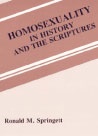
London-born Ronald Springett has a PhD in New Testament backgrounds and has taught at Southern College of Seventh-day Adventists for nearly 20 years. In Homosexuality in History and the Scriptures, Springett builds a strong case (inadvertently, no doubt) for debunking the notion of biblical certainty on the issues. He also represents opposing viewpoints fairly, even convincingly. Many gay Christians will no doubt find some reassurance in this. They will also find the book's defensive stance refreshing for a change: its stated purpose is to "look at some of the claims put forward in pro-homophile literature of the last decade or so."1
Adventists and
Homosexuality
Revisited