Antarctic Log
This is what a hot air balloon must be like, I think—this quiet, this smooth—seemingly motionless in the sky. Is this plane really moving, or is someone down there turning a huge crank that slowly rolls a magnificent picture from one spool to another like a player piano roll?
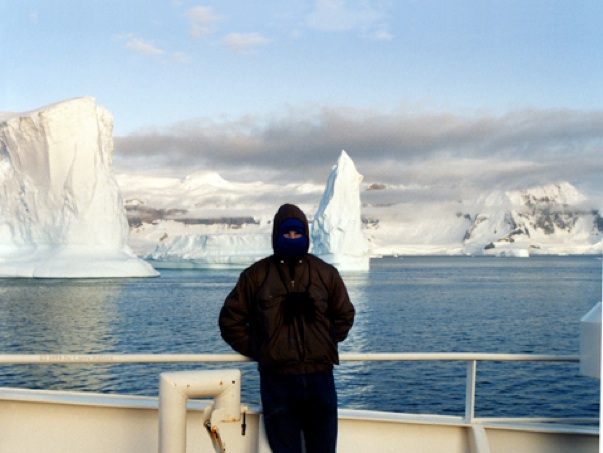
I selected this particular “picture roll” for the wonders it promised on the label: icebergs like giant ships, Chinstrap penguins at my feet, a 360-degree view of Paradise Bay. That’s the place that defines paradise, with its circle of glacier-capped mountains rising out of water so frigid and so abandoned that its only frequent visitors are the clouds that often fraternize at sea level undisturbed.
“Whadaya see out there?” a woman’s voice intrudes from across the aisle. I wish I had a bull horn to screech back a description of the angular island that appears to be unmoored in the water below. Aren’t there enough jokes about yappy seat-mates by now to make people think twice before shattering the tranquility of these finely tuned machines like fingernails on a blackboard? Or at least reserve it for Economy?
I reply with a facial shrug and ignore the question. ...Probably flying up here on an upgrade, I think, as I try to get back into my transition state.
That's what these big airplanes are, you know: “transition chambers,” great tubular machines that not only transport the body but transform the soul as well, from the mundane to the glorious, and back again. I am being both transported and transformed. The world where people work and play and fight and scurry about is already getting hazy for me as this machine puts it farther and farther behind me. Soon I will think it all a myth, that world, a place whose very existence will soon seem unreal in the distance. But first there is still one rather unpleasant worldly reality that stands between me and the glorious. I have yet to make the final payment for this trip.
Oh I paid what was owed in dollars. What I have yet to pay is my respect to the mean-spirited Drake Passage, that ribbon of water between the tip of South America and the Antarctic Peninsula. It is the world’s roughest sea, where three oceans come together spinning in different directions, ferociously clashing warm water with cold. No public flying machines of any stripe dare to challenge the Drake’s demand to exact its price personally—you can’t fly over it, commercial planes don’t go that far south. All visitors are required to meet it face to face. And the sailing there will hardly be as smooth as it is in the sky. But I have no inkling yet of exactly what price the Drake will demand: 48 hours of bowled-over homage on it’s angry waves.
A flight attendant releases the sash on the curtain that cordons off First Class from the economy cabin, careful not to let it simply fall gently into place. She grasps the edge of the curtain and, in a dramatic pause, looks directly into the eyes of the little people in Economy, then fiercely yanks the curtain shut in front of her face. I wince, and hope my reaction doesn’t give away my little secret: I’m usually among the insulted ones on the other side of that curtain. I furtively lift a corner of the flight magazine on my tray table and make a note on my papers underneath it, under the name “Lois.” It will be a demerit for her on the written report the airline is paying me to write.
I can’t say that I would enjoy flying incognito as an airline spy on every future flight of my life, but I don’t mind working a segment that I would fly anyway for pleasure, especially when the ride is free and I’m being paid for my time! And I could easily stay in this transitory state forever. I am waited on constantly by servants who call me by name. There seems to be an endless supply of Godiva chocolates. The bottomless bottle of Dom Pérignon is nearby. And who cares how marbled the filet mignon is, as a chef-hatted man sears it on a wok in the aisle of First Class?
I lift a journal out of my carry-on bag and place it over the magazine that hides my secret report. On its cover are the words, “Antarctic Log.” Little do I know—I will fill it up, even before I arrive.
Its first entry indicates this adventure started yesterday.
Wednesday, February 3— Forgoing the snooze button, I resurrect my bones against their will, swearing for the hundredth time that I’ll never schedule another flight before six a.m. I’ve allotted not a moment to squander, so it will have to be a quick taxi from my home to the subway that will take me to Chicago’s O’Hare Airport.
Steps away from my front door I spot a taxi in the distance and flag it like I’m doing calisthenics, but the cabby drives right on by, as though I’m invisible. Half a block beyond me, a black man who must have appreciated my antics manages to flag the cabby down—isn’t that a switch!—and holds the taxi for me. At least he tries. The driver continues to creep forward in spurts as though his brakes are faulty, but I catch up and throw my luggage and me into the car while it is moving.
The light is red, but the driver proceeds to narrowly miss a pedestrian in the crosswalk before stopping. Now it’s green but he waits a full twenty seconds to proceed, barely creeping forward as though he is not a taxi driver at all. “Where odd jew going?” he asks a third time, my luggage being an inadequate reminder.
“I’m sorry,” I say, “but I’m afraid this isn’t going to work.” I get out, pay him for the three blocks and flag another cab to the subway station.
Under ground, more minutes fall off the clock as I wait endlessly for a subway train on the northbound platform, while trains briskly come and go on the southbound side.
I recognize a pensive young man I had seen on this platform on my last red-eye to O’Hare. It occurs to me these are the working people who are here every day at this ungodly hour, and I feel conspicuous. They know who’s new to this O’Hare line platform at this hour, and they can tell who’s praying a flight will be delayed. I am jealous of the young man’s nonchalance as he drifts sleepily into thought. I wonder if he ponders his future, and how he’s getting ahead by paying his dues at such an early age—at such an early hour donning the brown pants and tan shirt with writing over the pocket, day after day. Just as he is about to flirt with the idea that maybe it’s not really worth it, the tardy northbound crawls into the station like a child expecting punishment.
The train is nearly empty except for its first car, which is overcrowded by people who’ve planned ahead to save steps at the other end. Among them is a tired woman in Goodwill clothes, with large eyes set in larger circles of grayish skin. She stares at me through those eyes as though she’s never seen a human. Nothing on her face moves. Even her eyelids seem frozen open. But her head swivels with my every movement as I squeeze around her and drop my bags onto the only floor space left, blocking the last bit of access to aisles and doors. She’s full of helpful hints, and they all spill out: I should stack my bags. She could help. I should hang onto that bar. She could hold one of my bags. Others should move. When the train lurches, I should stand a different way.
I smile, not at her weirdness (as others were), but because I love every taste of travel, and at that moment I realize the thrill of it anew. An exciting trip is officially underway again. I will see strangers differently from this moment on. I will notice them, interact with them.
I would fly to New York and spend the night with my friend Clyde before boarding this pampering 747 to Rio de Janeiro, with connections to Buenos Aires and then Ushuaia on the tip of South America for that dreaded meeting with the Drake Passage.
But to get to New York, I would first have to deal with an Airbus 300 out of Chicago, changing planes in Washington. And I would have to take a major hike inside the O’Hare terminal to board that Airbus which would no doubt be parked, like every plane I catch at O’Hare, at roughly Gary, Indiana. I suspect the close-in gates are never actually used for boarding. I think they are used as parking areas for those battery operated people-hauling carts when they’re not busy trying to run you down. I think the people milling about those close-in “gates” are actually extras paid by the airport to give the impression that your gate is in Gary only because the airport is so busy. Some of these extras are cleverly quite cosmopolitan, giving the impression they are travelers from all over the world who just happen to be crossing paths at—and isn’t this convenient—an international airport. The airlines pay these extras a little more than they could earn selling incense and sacred eschatological treatises… and everyone is happy.
When I get to the gate, the children, the disabled and the frequent flyers with Premier Executive status have already boarded, so being late has cost me my early-boarding privilege. Our take-off is slow and low enough to confirm that swimming pools atop Loop skyscrapers are dutifully drained for the winter. Then we climb fast and high enough to see both shores of Lake Michigan at the same time, a view I had no idea was possible.
“Hello? Mom? This is Ruth. Ruth! Can you hear me? Guess where I’m at! ...No, guess!”
Forty-something Ruth has a Hollywood Hillbillies voice that competes admirably with the drone of the Airbus engines. She sits four or five rows behind me, and entertains up to four or five rows ahead of me.
“I’m in an airplane. ... An airplane! I’m up in the air! ... Yeah! ... I’m looking down on everything right now! Yes, right now! ... Is Daddy there? ... Daddy? Guess where I’m at! ... I’m in an airplane. It has telephones, and I’m calling you!”
The world below is freshly covered with snow. Trees, rooftops, cars, entire farms—from here to the horizon—are all tucked beneath the giant, seamless blanket. The Great Lakes float giant puzzle pieces of ice on their share of the snow blanket. Like the drifting continents, they have pulled apart but are unshuffled. The winter here means summer in Antarctica—but a summer colder than a Chicago winter. It is the only season half-way hospitable to visitors, and then only on the peninsula. It never gets that friendly inland.
“Hello? Uncle Frank? This is Ruth.... Ruth! Guess where I’m at! ... No, guess! ... I’m in an airplane! They have phones in the seats! I’m looking out the window right now! ... Uh-huh. ... I think I’m flying almost right over your house right now!”
Closer to Washington the landscape changes from totally white to totally tan. It is textured by neatly organized ribs of what I presume to be sand dunes. These miniature mountain ranges divide the land into a geometric grid of one small valley after another, like a contemporary work of art. I’m imagining an artist’s signature in the sand and wondering how many lifetimes of travel it would take to use up all the surprises of things new.
“Hello? Millie?” By now, it seems the plane is tilting a tad, as passengers get up to get a look at Ruth on their way to the left rear restroom. Where else could they pretend to be going? The office of the Mile High Club was only thing at the end of the aisle that led past Ruth. And thanks to her, it seemed to be generating a lot of interest.
Ruth, who wore a straw hat at her seat to keep the reading lights off her fair skin, never got up to see what all the commotion was about. She had calls to make.
By tray-tables-up time, I had—in spite of Ruth—paid all the bills I had brought from home, written a letter and eaten six of the nine peanuts generously proffered by the airline. I handed the rest back to a flight attendant, explaining that I was just too stuffed to finish them. She had no sense of humor, and told me to put my tray table up.
As we taxied toward the gate at the airport in Washington, the door to the office of the Mile High Club popped open hard enough to bump the wall. I didn’t actually see who came out, one person or two. But a woman’s voice on the intercom repeated that all should stay in their seats until the aircraft came to a complete stop, and we knew the reminder was directed to a young couple returning to their seats with smiles on their faces that didn’t quite match the mood of the cabin. But..., who is to say?
During the stopover, I mailed my bills and letter in United’s Red Carpet Club, where wool-suited women executives sat at crowded desks trying not to look secretarial by hunting and pecking at their PowerBooks instead of typing. On a long, peninsular wall was a bank of twenty pay phones, with a male CEO tethered to each. Each man wore a dark suit, showed no gray hair past the temples, displayed at least some gold somewhere on his person, and presented a facial expression that said, “I’m buying and selling corporations! Yep, over the phone!” I joined them and practiced the same expression as I phoned the kennel about Royce.
When it was time to head to the gate for my connection to New York, a woman of about retirement age held the door for me. “I remember you,” she said. “I saw you on the flight from Chicago.”
Of course she had seen me. Everyone on the plane had seen me. They had all stared at me as I boarded. Puzzled, I had XYZ’d myself (Xamine Your Zipper) and checked my shoes for hitch-hiking toilet paper before realizing they were reading my tee shirt. “The Cure for the Blues,” it read, picturing the latest White House resident playing a saxophone. A friend had sent me the shirt, and I had decided to wear it in Washington with glee—but forgot I had it on. Since Clinton had just taken office, this was before anyone knew that a number of the women reading the slogan on my shirt would eventually be truly touched by the man.
When it was time to board my connection, I was ushered onto the tarmac with seven other passengers, to climb the portable metal stairs to a tiny turbojet with propellers for the hop to New York. It had a row of single seats left of the aisle, double seats to the right. They seemed only a little more substantial than folding chairs, with backs that sprung down onto the seat cushions when not held up by people sitting in them. There was one pilot and one flight attendant. They conversed in voice and body-language with a familiarity that made me guess them to be husband and wife, working as independent contractors for the airline. And I was right.
He told me his wife used to spend her days sitting at home wondering if she would ever see him again. But when she started flying with him, she became a new person. Now she lives to be in the air, he said.
She wore a cutesy waitress outfit of the 1940s era and went through the motions of a “real” flight attendant. For example, she recited the pre-flight FAA notices through a loudspeaker that needed to be only as loud as the natural human voice. I guess it’s hard to look official in a pip-squeak aircraft that has no cart to push up and down the aisle.
I’d ridden in small planes before, so I wasn’t as terrified as the others by our horrific dance with the sky during our fifteen-minute ascent. They thought they were breathing their last—and it made us instant family. Soon everyone would know everything about everybody.
“I would never have flown this segment if they’d told me it would be a commuter plane,” said the Red Carpet lady through the vibrations of take-off. “I just can’t believe they did this to me!”
I tried to explain the aerodynamics, telling her it was perfectly natural for small craft to float with the wind, and that quite often pilots are able to maintain control.
She apparently decided that if her whole life was to pass before her, she’d better get started. I didn’t have the heart to tell her most people conduct this exercise silently. So I learned that her husband, a chemical engineer for a plastics company, had traveled on the job extensively, and had accrued lots of frequent flyer miles which they planned to use after his imminent retirement. Then he died, and she’s seeing the world alone. Tonight she would have seen Helsinki, on her way to Asia. I convinced her she still might.
I also told her I once carried bags all over Europe for a rich lady and could do so again, without limiting myself to Europe. She didn’t seem to warm up to that idea.
A young woman of about nineteen or twenty sat across the aisle with both hands on the seat in front of her as if on an amusement park ride, bravely never closing her eyes. She and her two-foot-long pony tail were en route to South Africa for school. She had traveled in central Africa last summer, and now it was “in her blood.” With extraordinary confidence, she was able to answer all questions put to her about the continent, between the shrieks that accompanied every major dip of the toy plane.
Behind me sat a tall Rastafarian type with colossal natty dreadlocks, a musician returning to Jamaica after a reggae tour of Japan. He declined to perform a rendition of “Nearer My God To Thee.”
Amazingly, seven of the eight of us had foreign destinations. In fewer hours than there are in a day, we would be flung through the heavens from place to place until scattered to the corners of the world on five continents—Asia, Africa, Australia, Europe and Antarctica. But for that moment, our diverse lives converged in that tiny dot of space in the sky like Monopoly dice shaken together before being thrown.
I was thinking what a great disaster movie our little cast of esoteric characters might make on this flight of doom when a voice spoke authoritatively into the unneeded microphone, to direct our attention to Atlantic City below, which looked like a cluster of hotels on Park Place. I scanned the beaches for a glimpse of the boardwalk and the Drifters who helped make it famous by their escapades beneath it.
The world was blessed with eight lives rededicated to virtue that afternoon when the little airplane safely coasted to a stop in New York. Even the flight-attendant wife was silent, leaving the last word to the flop flop of the seat backs springing down over the cushions as we stood to gather our wits and belongings.
At the luggage carousel, the Rastafarian’s new life included wanting to chat endlessly while waiting for his luggage. I had carried mine on, so stayed with him only long enough to check out the dreadlocks up close. I wanted to know—are they all real, does he braid them or do they just happen, does he wash them, and why do parts of them look like carpet? One can hardly ask, so I said, “See ya. I hope your next flight is better,” and headed for the shuttle bus that took me to the city-bound subway.
At the Howard Beach station, subway trains run above ground. An armed security guard keeps a half-hearted watch on the deserted outdoor platform while I try to remember the details of a news story I’d heard about racial violence in Howard Beach. I pace the platform, aware of the seedy surrounds, wishing for a rush-hour crowd and considering how to react should harm approach. I see four teen-age thugs—so they look to me—come toward the station and disappear into its entrance under the platform, then I hear their voices on the stairs. Nothing I can see of the neighborhood looks truly ominous, but the rules for this particular experience are that you can’t know, so you cannot feel in control. I suppose they are the same rules that apply in Chicago subways when friends visit me, where I feel right at home.
A train comes and I am more concerned about getting on it than which way it is going. Inside I ask a man wearing thick but fashionably small glasses if the train is going toward the city or away from the city. He looks at me over the glasses and decides whether to respond. “Toward it,” he says in a foreign accent followed by another pause, as if waiting for me to tell him whether he got the answer right. I guess him to be about forty and at least partly Hispanic. He asks where I’m from and I tell him. He tells me where he’s from, but I have to ask him to repeat it. “North of Brazil” is all he says the second time, leading me to ponder whether I should try telling people I live “north of Mexico.” He and his family have lived in New York for four years. His wife loves it, he deals with it, and his children would kill before being “kidnapped” back to North-of-Brazil.
The man begins to list New York tourist attractions like the Michelin Guide while I study the artistic motif of the subway car. Neo-graffiti, I would call it. Then I realize he’s paused and it’s my turn. I tell him I travel to see people, and that I would shoot my last roll of film on people looking at the Taj Mahal before aiming at the monument itself. And I tell him my life-long experience with New York still holds: the people are exceptionally friendly, not exceptionally rude as is often reported.
The train stops and the North-of-Brazilian gets off as the conductor announces: “Next stop, Jay Street.” An elderly Asian, who looks Chinese with his white beard that narrows sharply to three or four strands, darts toward the door then pauses.
“Jay Street?” he asks himself aloud, trying to reach a decision before the door closes.
“Next stop,” I tell him. He moves his fragile frame back to the seat carefully, as if it can take only so much wear and tear. “You are just back from Tokyo?” I ask, seeing the NRT tag on his luggage.
“Yes,” he says, “I am Chinese, but I have been visiting relatives in Japan, and a son in Bangkok.”
The old man begins to tell me his history, laying a swath of color across the canvass of this trip in the space of a single subway stop. I race ahead of his words, mentally filling in the details of a life that I imagine might have produced such a dignified persona. And then I realize any aging Chinese man would look like dignity personified to me. Conversely, I suppose even the wicked ex-priest who was my boss at Howard Brown would look noble to Asians on a subway in China. Nevertheless, I sense that what I see in the old man is exactly what he is.
We get off at Jay Street and I smile at the man from China as I say the words, “Nice meeting you.” But what I fear he may have heard, as my faster pace left him behind, was “Up until Jay Street, I cared. But hey, this is Jay Street—now I don’t.” I feel awkward bumping lives with people and then just brushing them off like dust.
I phoned my old friend Clyde before exiting the turnstiles, and then waited for him on the other side as instructed, still in the cavernous subway of arching stone and ceilings which, for being under ground, seemed several times higher than necessary. A hundred high schoolers descended into the dungeon on cue and milled about with no apparent purpose other than to entertain me for the fifteen minutes I had to wait for Clyde, with their hot-color hairdos and “grunge” outfits. New York indeed.
I first met Clyde in Provincetown, on Cape Cod, nearly twenty years ago—we haven’t seen each other in ten. We keep in touch on birthdays and through each other’s postcards from distant lands.
Clyde emerges through the crowd of teenagers with a big grin and a hug to match, showing little evidence of the decade past. His hair is stylishly consistent with the current African-American look—completely missing. His slight speech impediment has not improved. I am again curious as to what caused it and whether he has had it since birth, but why ask now?
As we walk the half dozen Brooklyn blocks to Clyde’s apartment, he points out the various “’hoods within a ’hood,” each abruptly defined by its own kind of shops and foreign signs. To our right is a three-block-long Syrian neighborhood; to the left is a three-block-long Vietnamese neighborhood....
On the sidewalk we seem to dodge families, pets, people in foreign attire, vendors and rowdy games played by children from every part of the globe. We all inhale the uncontainable spices from an elaborate buffet in the window of an Indian cafe. A Chinese merchant shakes a pair of chrome eggs next to my ear so I can hear the chimes inside them. When I stop to photograph the living street, Clyde seems surprised at my surprise over Brooklyn. I explain that I now understand why so many celebrity guests on talk shows make it a point to announce they’re from Brooklyn.
We turn onto Clinton Street and I wonder exactly which of the Victorian row houses is the Huxtables.’ Stone steps, sculpted by generations of feet, follow wrought iron railings up to elevated first floors while steps downward are encroached upon by the ivy that camouflages entrances to garden apartments. All I have to do to experience the street as it was a hundred years ago is to ignore the cars. We stop at number 360 and trudge up to the third floor with my luggage—which by now seems to weigh twice as much as it did six blocks ago—to a two-bedroom apartment no bigger than a size small that shrunk in the wash.
Clyde lets me take a nap, and then we are off to a friend’s house, where African-American Clyde introduces me to Mitchell, who is Jewish, and the three of us continue on to a popular restaurant—which is Italian and oddly named “Queen.”
Over dinner Clyde talked about his job at Domino Sugar. The company was leaving the city and Clyde was among those who were offered excellent early retirement benefits if they didn’t want to relocate. In just three months, at age 49, Clyde would begin to spend the rest of his life exploring every corner of the world.
During coffee Clyde glanced at Mitchell and then said to me as casually as announcing the weather, “We’ve been together sixteen years. It won’t be easy with one of us retired and the other working.”
I dropped no silverware, and offered the impression that Chicagoans are as hip to big city stuff as New Yorkers. “I can imagine,” I said, trying to, “what parts of the world are you most anxious to see?”
Clyde was a good host, although I did not understand why he gave me six regular, standard size pillows to sleep with. In the morning he tiptoed off to work, allowing me a rare eight hours’ sleep. I spent the morning at Clyde’s sipping coffee and soaking in a warm bath while running the hot shower overhead for an hour without ever thinking of a gas bill.
I would never see Clyde again. A month later, a woman would open the left door of a Manhattan taxi in front of him as he bicycled to work. He would swerve reflexively, just in time, but into the path of a truck. Mitchell would phone to say the body was being cremated. In that conversation I would find myself wondering how Mitchell could possibly cope, and wondering what I could possibly say. And I would remember the night I slept with six pillows at Clyde’s place.
But that was a future still unknown when I ended my afternoon of people-watching in NYC and headed back to JFK where by now this great machine I’m in would be waiting to transport me from this world to another.
It is dark outside the 747 now. I note in my Antarctic log that Rio is still three hours ahead, then I close it to observe the activities of the flight attendants before taking a nap. After all, I am being paid to do a job in this First Class cabin. I check their name tags again for accuracy and then look elsewhere for a while, as if pondering my memoirs, before noting in my report that they offered ice water at 2:55 a.m. It has been more than three hours since they last offered it, violating the standard for international flights.
I tuck the report forms and my Antarctic log into the flight magazine and stuff them into the seat pocket in front of me. Then I recline my seat as slowly as I would in Economy—before realizing the spacious recliners in First Class cannot possibly bump anyone—and close my eyes. But a Nigerian I met earlier won’t let me sleep, so I bring the seat forward again, pull out my papers and transfer the African to a page in my log.
Several hours ago, the young man and I were both on the crowded shuttle bus that got me to the airport for this flight. He had smiled and remarked about my unwieldy luggage. I saw the ID card on his shirt, and noted aloud that he worked at the airport.
“Oh, but I am a preacher, too!” He makes this announcement with a great burst of energy, as though the airport job is nothing at all in comparison.
“Cool,” I respond, “my brother is a preacher and I used to be one myself.”
“But why not now?” the Nigerian asks robustly. “God still wants you,” he says a little louder and without waiting for an answer.
Instantly the man is certain—absolutely so—that God still has his hand on me, as he put it, and that I will in fact get back into the ministry. No questions asked, no information to go on, and having just met me less than sixty seconds ago, he knows God will not let me “get away.”
Now let me confess up front, I cannot resist egging these types on. It’s in my genes, I am helpless to control it. So when he said my leaving the ministry meant I had gotten away from God, I decided to bait the hook.
Usually I inform intrusive itinerant preachers, or anyone who tries to proselytize me, that I am a hopeless druggie or that I have served time for killing prostitutes. This time, however, with Clyde’s revelation still on my mind, it popped into my head to say, “But does God take gay preachers?” Then I waited to see how much of a New Yorker the Nigerian had become. Would he yawn, or would it be time for church?
At one octave higher and several decibels louder, it was church. He launched a complete sermon and delivered it with the certainty of a master psychic: God still wanted me, I would still be a preacher, and I would be in heaven. He was excited to bring me this good news.
It was a friendly tirade, not a hateful one. And he seemed sincere behind those sparkling eyes set in an exquisitely chiseled ebony face that never stopped smiling. I almost felt guilty continuing. “How so?” I asked, “I thought sinners wouldn’t make it to heaven.”
“He will change you! He will change you! Even at the last minute! He will!” His words came automatically, he didn’t need to stop and think.
The African was energy personified, and the salvific pitch escalated. Although I didn’t care what his captive audience on the bus assumed about me—I’d never see them again—the sermon did nevertheless have one effect on me. It made me pray: “Oh dear God, please don’t ever let me pull this stunt in Chicago where people know me!”
Up to now, there was a certain charm to all of this exuberance, delivered in an exotic-sounding African accent. But as the novelty of the Nigerian’s proselytizing began to wear off, I felt responsible for what might become an annoyance to others on the bus.
So I prayed again, this time for the man’s stop to come quickly. But stop after stop went by. Other airport employees were getting off, why not the Energizer preacher?
“I will speak to you in heaven.... God will okay you to be there! It is a promise!” If the gospel is, as they say, “the good news of salvation,” then I hadn’t gotten this much good news since my last A in high school.
Eventually my prayer for less good news was answered. The oversized double doors on the side of the bus opened and the handsome preacher stepped out. He turned around, flashed a big smile into the bus and joyfully shouted “See you in heaven!” as the doors closed against his melodious words. As the bus began putting distance between the man on the pavement and the part of him that would settle into a corner of my mind, I thought: I suppose I will see him in heaven. After all, he seems like a nice guy, and God’s patience toward his well-intentioned supporters is surely big enough.
At the moment, God seems a little busy, distracted perhaps, for there’s a growing turbulence in the midnight air. The sleeping People of Class who are strapped to the big recliners in the front section of the giant transition tube are beginning to stir. Flight attendants start offering drinks. Lois speaks to a First Class customer without addressing him by name—she’ll get a demerit for that.
I request tomato juice straight up. Within hours I will face the formidable Drake Passage, and after forty-eight hours of that, my transition from the mundane to the glorious will be complete. I will be surrounded by natural wonders few humans have ever seen, at the bottom of the world where the shortest distance to home is a straight line down—or would it be up?—through the earth’s core.
I review the last entry in my open log, and think about the world from which I am temporarily taking leave—a vibrant world of cabbies and preachers and Ruths, and a friend who took twenty years to tell me who he was.
I write “The End” at the bottom of the page in my Antarctic Log and close the cover without changing its title. When it’s time to pay my respect to the Drake Passage, I’ll start a new one and call it a sequel.
______________________
Copyright © 1993 by Larry Hallock
Notes on “Antarctic Log”...
One day as I was going through my files, I found an account of my Antarctic trip a few years ago, scribbled on pages from a yellow legal pad. Since I hadn’t remembered keeping a detailed record of my trip, I was glad to discover these extensive notes. I was initially disappointed that the entire account described only the first part of the trip—getting there. (It’s not surprising that my notes stopped there, since it was nearly impossible to write notes from that point on, given that we were rocking on water most of the time.) I was amazed at the amount of detail I had used to record the many characters I had encountered just between my home and the 747 that took me from NYC to South America.
It was a joy to remember these details again, but I wasn’t so sure, and I’m still not certain, that people would find a description of this string of characters to be interesting reading from a travel perspective, especially when such cursorily encountered characters cannot be further developed in a nonfiction work describing brief encounters. But I read stories from all sorts of angles, and I suspect that travelers who, like me, travel more for the people and the culture than for the architecture and entertainment, might find some resonance in this account.
All the characters in the story are real, and their dialog as verbatim as I was able to record them at the time, although “Ruth” was encountered on a different trip. Also, I do not have a dog named Royce, and readers who know me personally will correctly suspect that I knew all along that Clyde was gay and that I didn’t have to nervously change the subject. Except for these specific incidences of minor literary license, all details of this story are true.
From conversations with other writers, I know most of them engage in far more “literary license” than I would ever dream of doing, myself—even to the point of introducing fictional characters and events into supposedly non-fiction accounts. Yuck! This was like finding out Santa isn’t real all over again. And especially yuck for travel writing, which, in my view, should tell it essentially like it was. [Later note: now I have become aware of the difference between a travel story and travel writing, as explained at the top of my travel writing page. But aren’t most travel stories taken as non-fiction by the public?]
This piece did not go over well in my writing seminar, and I could see why. Written ten years earlier, it was loaded with basic writing flaws, to say nothing of it’s length and boring detail in a rather pompous style. So I’ve re-written it over time, and I’ll continue to drag it out and dust it off now and then for more editing. The first half seems more boring, and too loaded with attempted humor that almost certainly doesn’t work. I have to ask, is this supposed to be funny or serious? Should it try to be both? (Comments and advice are always appreciated.) If I dust it off enough over the years, it might become something of interest eventually. But if not, well, it’s really for me, anyway. It is a diary of memories that I enjoy reliving.
I remember taking copious notes on this trip was new for me. Too many times I’ve come home and tried to remember and write, but so many things escaped me. I always determined to take copious notes the next time. I’m getting better, but back then I rarely did it as copiously as I did for this trip. (Having lots of time in a plane on a long flight was the enabler.) When I found the “lost” notes, they vividly brought back characters and events I’d actually forgotten—in all this glorious detail. When I think of the countless details lost on other trips… what a shame!
My longest story—but will it ever get you there?
by Larry Hallock
© 1993 by Larry Hallock