
by Larry Hallock
"Look around," said the antique dealer, commanding my attention away from the civil rights posters for sale in the window.
I had noticed the antique shop as I hurriedly nosed my rented car into a diagonal parking space on Broad Street near the foot of Selma's notorious bridge on the east side of town. With only minutes left to spend on this tightly scheduled visit to Selma, and the bridge still ahead, my antique-store diversion had to be quick.
"Okay," I replied without moving. I studied the only poster in the window that appealed to me at all. But even it seemed trite. Surely I could find a more creative memento of the day's sobering retrospection than a cheap poster of Martin Luther King, Jr.'s face. I pictured millions of them, unframed, taped to faded walls across the country. I didn't want folk art.
But most of the other posters were even more mundane. At least this one wasn't painted on black velvet! And the collage of local civil rights icons forming the border did give the work distinction. Why had the artist relegated them to the sideline? Would anyone really notice Brown Chapel painted into the border? Or the bridge? Or the road sign pointing the way to Montgomery?
The shopkeeper seemed uneasy that I should pause to study the African-American memorabilia. "Uh, I do, uh, have a number of black customers who come in here occasionally, so I try to have, uh, you know, some things of interest to them."
His apology irritated me. What a mistaken approach to this potential customer who had just traced that solemn, historic path through town from Brown Chapel, past the historic, drab-green county courthouse, and down Broad Street to the foot of the Edmund Pettus Bridge!
I loved Selma the moment I drove into town. It wasn’t the gritty Alabama metropolis I had conjured, it was surprisingly country: one main street lined with restored Victorian facades, quiet side streets with weeds growing through the pavement, grand porches on small frame houses, empty lots of unmown grass. And diagonal parking. I grew up around towns like this in Kansas—although they had no quaint antebellum architecture, and no really old, ornate storefronts like Selma. Something about this pleasingly old-fashioned little town made me feel I'd known it well since childhood, yet something else made me feel I didn't know it at all, and never really would. Its quiet, sun-clobbered streets were still haunted by the martyrs of its shameful past. I knew it, and I could feel it.
"Well, you know how it is," the antique dealer continued anxiously after a full minute or two, "their money spends the same as ours." He stepped back and gestured toward the rest of the store. "I have a lot more things!"
The white proprietor seemed visibly puzzled that a white customer would fix such attention on a few cheap tourist souvenirs—black souvenirs—displayed in such an unlikely place. He didn't know how much I regretted being too young and too unaware to become a part of the historic civil rights movement, a major piece of which unfolded right there in his own home town. He had no idea my visit bordered on pilgrimage.
My slow burn went to full flame. What assumptions was he making about my values? "I guess maybe things haven't really changed all that much, have they?" I said after a pause, and with an intentionally ambiguous composure.
"What do you mean," he asked, missing the barb.
"Oh, I don't know—," I said, moving on to the rest of the store. I decided to hold any rebuke in check a while longer. What else might he unwittingly teach me about today's Selma?
"I'd love to spend more time in here and in Selma—but I have a long drive ahead, and then a plane to catch. Maybe I should try to postpone my flight and stay a little longer."
The antique dealer offered me the phone in his office and politely left the room while I used it. He then gave me brochures on Selma and related fascinating anecdotes about the town's (non-race-related) history. He was the perfect Southern Gentleman. Except for those ridiculous apologies!
I studied the display of posters again and wondered how I could rationalize spending money in a store where excuses are made for a few pieces of black art.
Time was ebbing and I had been unable to postpone my flight, so I told the man I'd think about it. I said I might return. I knew I would return, purchase or not, because I knew I would have something to say.
Closing the door of the shop behind me, I turned right and stopped in the scorching sun to gaze upon what I had come to Selma to see—the infamous Edmund Pettus Bridge. It is a clunky contradiction in design, part of it arching high in the shape of a graceful rainbow, yet formed of heavy steel and concrete as gray as a rainy day.
As I approach the historic site, I feel my heartbeat speeding up. I know I walk a bloody path. From the bank of the Alabama River below, a mighty magnolia tree watches the bridge and seems to focus its attention on the scene as I come nearer. Its branches slow their sway, then stop as I step onto the Edmund Pettus Bridge. The arch of the bridge is such that I cannot see the other side. But I don't need to see it, I already knowing the history. I know that nothing good awaits me at the end of this sad rainbow.
I feel the heat of the baking pavement through the soles of my shoes. I will conquer the incline slowly, tracing the steps of martyrs past.
Soon it seems that other feet have joined me, hundreds, from the past. We’ve talked the talk, and now we join hands to walk the walk. A youngster tugs on a woman's dress. "Mama, why are we walking? Why are we walking to Montgomery?"
"I don't know…. I just don't really know," she mutters inaudibly. She does know, but it's a deeper question than the child can fathom, and the powerful words she just heard at Brown’s Chapel about the right to vote seem impossible to translate into childspeak.
"Get up here, and you kids stay together before you get lost," she commands. "It's fifty miles. This is important...."
Soon a bottleneck develops at the top of the massive arch. The marchers slow their pace. I push on until my vision crests the top of the bridge, and then I see it at the other end: the barricade of mounted policemen, husky men with clubs, kids with rocks. Human barbed wire.
Our breathing stops, yet our feet keep moving, more slowly now. Down the other side of the ugly rainbow they take us, down the deadly path. "If we die for this now," some rationalize, "the movement will be robbed of our future contributions...." Yet on we go, determined.
Below me I see the Alabama River flowing like the words that are coursing through my mind: "...until justice rolls down like waters, and righteousness like a mighty stream." Such words seem stagnant now, in the face of brutal clubs. Yet on we go, driven, as if blindly, bracing for the blows—bracing for the blows.
But wait. Cars are moving on the bridge. No one else is walking. The raucous mob ahead has faded, disappeared. I see only mental footprints where my companions walked so many years before. I cross to the other side of the Edmund Pettus Bridge and start back down the incline. Step by step I put the bridge behind me, reclaiming my composure as I approach the western bank. The old magnolia still gazes on my Mecca. I see it settle back, relaxing, branches loosening to the breeze again. I think about the antique dealer, and whether to buy the work of art.
I stepped off the bridge and turned right, opposite the antique store, to stroll the lushly lined river. Fifty feet away, two men busied themselves with red bricks to create a winding walk to the front of an old yellow frame house that clung precariously to the side of the river bank with the aid of stilt-like two-by-fours. They worked quietly. The older knelt beside the walk that he was forming, trowel in hand. The other, about forty, stood bent at the waist, feet apart for balance as he sorted the bricks one by one—slow but steady movements in the quiet; dark, weathered faces glistening in the heat; worn hands, leathered by years of Southern summers’ toil.
I stopped five feet from the men of African descent, but they chose not to notice me. To them I was a city inspector, perhaps. Or a construction company supervisor. Or maybe I was from the historical landmark office whose plaque is on the front of the aged structure. Surely I was checking up—I was anybody but somebody just wanting to talk to them.
"I saw this old house from the bridge." No attention getter, that.
"Looks a bit precarious!" I tried again.
"Oh, it's not as bad as it looks," said the older man, finally giving up one quick, guarded glance without missing a stroke of the trowel. "It's propped up pretty good."
"Well, I don't think you could get me to sleep on that side of the house!”
Outreach accepted. Faces relaxed. Bodies straightened, paused, gave attention.
"I'm from Chicago and had business in Montgomery, so I decided to swing by here to see the bridge—and walk across it." If you catch my drift, I added mentally as I pondered both the moment and the history. I was in Selma and here were people who lived on this holy ground. The bridge is a fixture in their daily lives. Say something momentous for me, please!
"When I saw this old house from the bridge, I was afraid it might fall into the river right before my eyes!" I said.
Okay, I thought, for momentousness I'll have to press it. "How long have you lived in Selma?"
"Oh, fifty years," said the older, "about all my life."
"So you saw it all," I said, hoping he'd pick it up from there.
"Yeah," slowly and thoughtfully, "yeah." Long pause. I waited for him to continue. "How long you been here?" he asked.
"Oh, about forty minutes," I said.
A chuckle or two. Touristy small talk. Then back to my point: "Has anything really changed?" I asked.
They replied simultaneously. "Not much," said one.
"Oh, a little," said the other.
Long pause. Say more, say how you feel, I implored silently. I’m from the North, you can tell me.
"Jobs. The economy—you know," added the first, apparently in polite afterthought.

"You guys take care...." I walked away hating myself for romanticizing the moment instead of getting to know them and Selma better. I could have asked some direct questions, started a discussion.
Then I saw another great magnolia, right beside me on the bank. It had witnessed our entire conversation, just as it had watched the beatings on the Edmund Pettus Bridge on Bloody Sunday thirty years ago. "You're right, I too saw it all," it seemed to say.
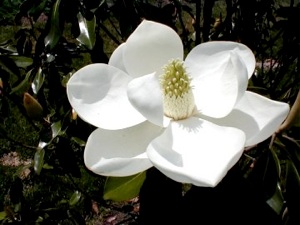
The aging Southern tree displayed just four blossoms. I imagine it turned a thousand giant flowers toward the awful sight that day; maybe that's what made them die, and only four remain. More likely it was merely some kind of "Dutch magnolia disease"—or just the end of the flowering season. But this day four were still hanging on, as if Remembering, Waiting, Watching and Hoping.
I studied the bridge again through the eyes of the old magnolia, then turned and walked back toward my car and the antique shop. There was still a plane to catch in Montgomery. Should I buy the poster?
I approached the door of the shop still undecided on giving my business to the antique dealer, but determined in either case to “witness,” to clarify my sympathies. I reached for the doorknob. It was locked.
"Back at 2 p.m.," a note read. I looked at my watch. It was 2:03 p.m.
I got into my car, crossed over the Edmund Pettus Bridge and headed east out of town.
Bloody Sunday occurred March 7, 1965. Its shocking publicity jarred America's consciousness to the plight of Southern blacks. As a result, people from all over the country—including many whites—flocked to Selma to participate in a reorganized voting rights march, which occurred two weeks later. This time marchers crossed the bridge and arrived without major incident at the capitol in Montgomery five days later, on March 25.
Weeks after my visit, I phoned the local museum for additional information on Selma. A woman explained about the precarious yellow house, saying a rare river flood had nearly washed the landmark away. Its restoration was considered so dangerous that the City did not require any of its employees to participate in the project. Only those who volunteered—including the men I talked to—were assigned. That very evening a party was to be held at the museum in celebration of the completed work. A special cake in the shape of the house was already laid out, awaiting the revelers.
Copyright © 1995 by Larry Hallock
The historical record, in less than 4 minutes:
Magnolia blossom
Photo: unknown
Forty Minutes
in Selma
...Until justice rolls down like waters, and
righteousness like a mighty stream.
Return to Travel Writing
Return to Race Issues
Click
directly
on the
button.
To replay, refresh the page.