
Looking on the lighter side,
let me say that nothing is small at a General Conference session. Thousands of prepaid, set-menu meals were served from a dozen cafeteria lines during meal breaks. The Adventist Review was published daily. Slick television coverage of G.C. sessions and news was provided via satellite to selected local churches and cable stations throughout the world. Twenty-two revisions to the Church Manual were considered during the business sessions.
The financial report to the delegates was 36 pages long. (Total G.C. assets: nearly $175 million. Total tithes and offerings last year: nearly $1 billion.) Music was grand and top notch. Examples: Wintley Phipps, Del Delker with the Oakwood College Choir, and a combined orchestra and chorus that filled a giant platform with more than 400 individuals.
Scores of seminars for pastors were offered (by the World Ministers Counsel, headed by Floyd Bresee) on nearly every conceivable topic except homosexuality and AIDS. The president of the Seventh-D Baptists and other religious dignitaries addressed and/or visited the Conference. Each evening a different world division made its grand presentation of music, costume displays, reports and professional P.R. video—and I do mean slick and professional. (I noticed the report from church leaders in Africa did not even mention AIDS as on of their challenges for the future.)
Copies of seventy-five official audio and video tapes of the session were offered. Right after sunset on Sabbath, hundreds of tapes of the morning sermon were sold—all boxed and labeled already. (Don’t ask.... I wondered the same thing!) Perhaps a hundred booths offered information on everything from G.C. departments to church institutions to independent ministries. Church luminaries such as George Vandeman, as well as humble peasants from fields afar staffed the booths and wandered through the exhibits.
Was it exhilarating? Yes. Was it a Kinship Kampmeeting? Far from it. I shared my feelings of exclusion and alienation at this General Conference session with the G.C. department that exists to listen to the needs and concerns of minorities and others in the church who want to be heard. The woman staffing the booth for that department suggested with a most confident air that I must be wrong to think one group is still excluded. I filled out her survey and she promised to pass the word along.
by Larry Hallock
It’s old news. The 1990 quinquennial session of the General Conference is history. But in case you haven’t heard, a new church president was elected, a new division of the church was established in the USSR and women’s ordination failed. Gay issues were not on the agenda, and Kinship did not make a visible presence.
Fifty thousand Adventists from around the world gathered to participate in—or just observe—the colossal business meeting and sundry celebrations held in the Indianapolis Hoosier Dome in July.
About 2,500 attendees were official delegates charged with electing certain officers, hearing world reports and voting on items such as women’s ordination, amendments to the church’s constitution and bylaws, revisions of the Church Manual and statements on Sabbath observance and the Spirit of Prophecy, etc.
No one seems able or willing to guess how various issues facing the church might be affected by the change in presidents. All seem to agree that the man has an especially keen mind and will implement innovative ideas; but there is no consensus in speculation about the fate of issues such as the role of women in the church, trademark lawsuits and doctrinal emphasis.
Perhaps both aspects are reflected in Folkenberg’s statement, “We must now allow pressures of a changing society to weaken our commitment to the fundamentals of our church; on the other hand, neither should we allow ourselves to trap our future in the thought modes of the 19th century.”
Folkenberg became the new leader immediately upon election. On Sabbath he called for unity in a sermon punctuated with frequent applause, much in the flavor of a political convention. “Unity is not uniformity,” he said. “If God had wanted a church of uniformity, he would not have made flowers of different colors and birds with different songs.” He admonished against judging and criticizing others. “When we try to judge others... we appropriate to ourselves a prerogative which God reserves for himself, and that, brothers and sisters, is a description of blasphemy.”
Ordaining women to the ministry might have passed a North American Division vote; but it’s a world church—predominately a conservative third world church—and the world church voted. One person who spoke from the floor proposed that the church take a step backward and withdraw ordination of women even as local church elders. Another warned the assembly that if the church decided to ordain women, next thing you know, it might ordain homosexuals. “Yes, and then Ninja turtles!” whispered a woman to the person in front of her. (This was the only public reference to homosexuals at the Conference that I’m aware of.) When the extended discussion was over, things were left where they stood after Annual Council a year ago: women may be licensed ministers and authorized to do anything an ordained pastor can do—marriages, baptisms, etc.—they just cannot be ordained like the men.
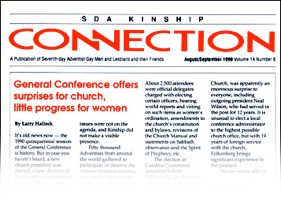
General Conference session
offers surprises for church,
little progress for women

I did other “witnessing.” A tuxedo-shirted young man got in the cafeteria
line behind me. I complemented him on the music his group had performed and then told him about Kinship. I had no inkling he was gay until the end of our conversation. He seemed happy to learn about our organization.
One night I observed some radical conservatives who were picketing the massive crowd outdoors between meetings, carrying signs decrying “Trademark Religion,” a reference to the church suing various groups over use of its name. As I turned to walk away, another bystander, whom I had not seen, spoke to me with small talk about the spectacle. I said I found it all very interesting, “because I’m on the board of SDA Kinship and we are one of the groups being sued—because we are gay.
“I have a problem with that same issue,” he said.
“That issue?” I asked, thinking he must mean the church suing people.
“I have that same problem,” he clarified, “being homosexual. But I’m working on it, I’m going to get some counsel. People can get over it, and I’m going to be all right.” After a moment of reflection, he said, “You know, it’s funny, I was just talking to another guy about this same problem. He had it too, the same thing. First him, and now I run into you. What made you speak to me?”
“I didn’t,” I said. “You spoke to me.”
“Oh, yeah.”
“Do you believe in providence?” I asked. I gave him Kinship’s toll-free hotline number, and left with a sense of sadness that it can be as difficult getting through to people just getting started on the road to discovery as to some of our church leaders.
I also distributed some “truth-filled literature” (Kinship publications). Folks, I cannot tell you how good it feels to be out of the closet to everyone and confident in truth. Even at Union College’s mini-reunion at G.C., I happily met old friends and old girlfriends with the greatest of ease. That was a good feeling to encounter and it’s something I’ll remember about this General Conference session.