

Landmark issue on Homosexuality
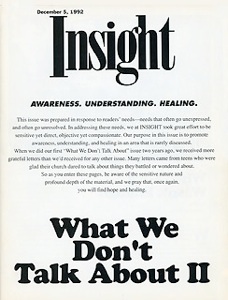
The Church’s official youth paper.
Changing sexual orientation is “difficult and rare?”
I have to chuckle every time I see that phrase in Adventist circles. It all started when I used that phraseology in the Kinship brochure a couple of decades ago, where, last I checked, it remains ensconced. Chris Blake consulted with me on the landmark issue of Insight and referenced the phrase in his article. A number of others have referenced it here and there, even Samuel Bacchiocchi in one of his papers. I chuckle because I knew when I first wrote it, that it wasn’t true, yet no one has challenged it. Changing sexual orientation is not difficult and rare, it is virtually impossible. Highly motivated individuals might be able to move one or two points on the Kinsey Scale of sexual orientation, if they try hard enough and long enough, but people don’t move from one end of the scale to the other; that is, not from essentially one orientation to essentially the other.
So why did I use that phrase? Simply to give every benefit of the doubt to the audience we were trying to reach—people who already believed change was easy and frequent! I left open a remote possibility with that phrase. Meanwhile, I’ve often wondered why nobody ever popped up to say, “See, you admit it can happen, albeit difficult and rare!” If it ever happened once in the world, then surely it can be required of all, the thinking would go. Oh well, no harm done so far.... and hopefully not in the next couple of decades either. -LH
by Larry Hallock

You’ve never seen anything like it in the SDA press before, and may never see it again—who knows? The entire 16-page issue of last December’s (1992) Insight magazine, the church’s youth paper, was devoted to promoting “awareness, understanding, and healing in an area that is rarely discussed.”
The paper had already tackled certain taboo topics two years earlier in a groundbreaking issue titled “What We Don’t Talk About.” But when the last page of that earlier issue had been turned, one topic still wasn’t talked about. Not because editor Chris Blake didn’t want to talk about it then, but because discussing homosexuality directly and honesty with the youth of a conservative church poses a most formidable challenge. The integrity with which he succeeded is almost breathtaking.
The remarkable thing about the December issue isn’t that it came down in favor of committed lesbian and gay relationships. It didn’t. It called for celibacy. But it addressed gay issues with a passion for objectivity not even approached by any Adventist publication before.
In the opening story, “When Love Wasn’t Enough,” a young man tells his girlfriend he’s gay, and drives home the point—for her and the reading audience—that he didn’t choose to be gay, and that changing wasn’t a workable solution.
The central article is written by the editor himself, who opens by describing his confusing emotions when a college-age friend came out to him years ago. Then he describes the 1986 scandal at the Quest “change ministry.” After the program’s failure, the editor says, he “waited for my church to issue a proclamation or an apology or something that began: Though we acted in good faith, we could have made a mistake by suggesting that Quest was the answer to homosexuals’ problems. We need to do more for this group of church members. For the future, here are some tangible ways we’re going to help homosexuals....’ So I waited, and waited, and waited. I’m still waiting.”
Reader Responses
The April 3, 1993, Insight contained ten reader responses, evenly split. The negative ones were emphatic: “I knew the church had problems, but your issue of December 5, 1992, is open rebellion against the Spirit of Prophecy and the Bible,” said one, without citing references. “Unless there is an immediate ‘official’ rebuttal, my funds are withdrawn from any material that comes off the presses of the Review and Herald [Publishing Association]....”
Several readers said they personally know several people who have changed. A friend of Colin Cook wrote to endorse his program. And Mr. Cook himself (as reported in the April Connection) criticized the editor for not contacting him for input on the special issue, saying he knows lots of people who have changed. As for himself, “That crisis in 1986 enabled me to break with the remaining homosexual behavior and see an orientational shift that is now almost total.”
Later note: That did not prove to be the case for Colin Cook. Improprieties were again documented two years later. And as for his habit of saying he knew lots of people who’d changed, he could never produce anyone who’d really changed from gay to straight—not even himself. When he spoke of “change,” he referred to changing “by faith,” or to certain behavioral changes—not orientational change, in reality. See full discussion in “The Sad Lives of Colin Cook.”
There are a few shortcomings, though, from my gay perspective. Celibacy is too easily prescribed for gay Christians; it’s presented as hardly different from asking heterosexual singles to remain celibate. I would have liked more to be left in abeyance in this regard, and I wish the ambiguity of scriptural passages had been stressed more—so that young gay readers would feel more comfortable forging their own theologies. I thought the heading “There is no scriptural support for practicing homosexuality” said a lot about what the Bible does and doesn’t say. Must the case for celibacy resort to such a defensive stance? “Read any of the biblical texts that mention homosexual acts. Not one says homosexuality is in God’s plan for humanity.” I don’t suppose taking an aspirin or going to the symphony is in there either.
Along with the article’s clear picture of orientational permanence (“changing is difficult and rare”), healing is called for and homosexual readers are urged to refocus on a “new identity” and to contact one of the “healing ministries” listed in a sidebar. The author reassures the gay reader that God’s love is unconditional, even when we slip up, but I wish a stronger message had come through for those who will never succeed in changing.
Amazingly, Kinship is listed among a short list of “healing ministries”—but without contact information: “SDA Kinship International, Inc., a support group for gay and lesbian Seventh-day Adventists, believes that ‘God can bless a committed homosexual relationship.’ Although one need not be a homosexual or sign a statement of belief to obtain input from the group, since theirs is not our church’s stance, the Seventh-day Adventist Church organization has disassociated itself from Kinship.”
The articles end with a conclusion that says pretty much all the right things—wonderful things—including a strong, non-perfunctory call for compassion and right attitudes. It includes the story of Bobby, who ended his own life at age 20 because of homophobia. “Before you echo ‘amen’ in your home or place of worship,” pleads Bobby’s mother, “think and remember... a child is listening.”
What kind of a man could bring such a progressive (for this church) work to fruition? “I didn’t want to write this article,” he tells readers. “For a long time I put it off. And I don’t intend now to become a spokesperson for homosexuals; for me this is not an all-consuming platform. I’m telling you this because (probably like you) I wasn’t naturally drawn to this topic, but I heard too many desperate, heartbreaking cries in the wilderness of our church to ignore them.
“It is our duty—mine and yours—to alleviate suffering and to generate awareness, spawn understanding, and foster healing where we can, even when we are not ‘naturally drawn’ to do so. To encourage, uphold, and point to our all-sufficient King when others are fearful is also more than our Christian duty—is our joy.” # # #
The full text of Chris Blake’s article in the special issue of Insight is here.