
by Larry Hallock
You'd think I were Anita Bryant the way I was blasted several years ago when, in a letter to Chicago's GayLife, I examined the merits of gay parades. For those unfamiliar with these parades, they are held in larger cities every June, since 1969, to commemorate a turning point in gay liberation, the Stonewall Riots. The parades display marchers and floats that represent various gay establishments and organizations, and in more recent years, a plethora of commercial advertisers and politicians. Anti-gay politicians, fundamentalist preachers and homophobic news people have made “good use” of film footage of the lighter parts of the parades in which some have, shall we say, let their hair down a little. Sometimes a lot.
I still have some reservations over the merits of gay parades, but for a different reason now. Back then I was dismayed because I thought the parades seemed to tell the world, “Look, this is who homosexuals are!” I didn’t want straight society to think that everything it was seeing in the parade was me.
Today I am more open to the various other views of the parade, such as the one that sees it as a big party—a celebration not intended to educate straight society.
But my different, graver reason for questioning some aspects of the parade today is because of what it says to us, not because of what it says to the straight community. To us it can seem to say, “Look, this is who we are!” It can tend to convince us that we are as flimsy and frivolous as it is. This can be dangerous to our own self-esteem, especially for young people just beginning to understand their sexuality. Telling ourselves that the parade is us is worse than telling it to straight society.
Certainly float after float of this bar and that bath is not who I am. Ms. Lesbian So-and-So is not my lesbian friends. Mr. Gay This-or-That may be gorgeous to look at, but he does not reflect who I am, was, or hope to be; nor does he reflect who most of my gay acquaintances are. The lineup of religious support groups in the parade is not me, either. I am neither my sexuality nor my religion. I am all of this and more—much more than a parade could represent.
Some will say the parades are not really taken seriously, and that let-your-hair-down parties need no validation other than their inherent fun. There is no banner at the front of the parade alleging that it depicts a representative sample of the gay community. Nevertheless, the parade does ask us to take it seriously. Rallies are held in connection with it, press coverage is solicited and serious floats are entered. Part of the parade is party and part of it isn’t. Much of it is political—in some ways not even remotely related to gay rights.
The parade tries to be everything, but since it can’t, that may be too much. Others might be starting to agree; gay newspapers reported that the giant Los Angeles parade was poorly attended last year.
A more clearly defined purpose, along with a much better focus, might improve the parade. So might having it every five years or only once a decade. Changing its name might be appropriate: “Gay Rights Parade” or “Gay Party Parade,” depending on the purpose.
We now call it a “pride” parade, and I understand the intent, even as I know it makes no sense to be “proud” over simply being. It is possible to stand at the parade feeling happy and good (which isn’t bad) without necessarily feeling pride. Somehow a large collection of bar and beer advertising and the fact that we can sport a beautiful Mr. This-or-That in the open air isn’t what makes me proud; it only makes me entertained. (Floats for pure water wouldn’t do it, either.)
Actually, I have felt more pride in reading the obituary pages these days—which many of us have been doing lately [during the worst years of the AIDS crisis]. Not infrequently we see a headline something like: “Bob Smith—NASA Space Engineer.” And we read that Smith, 36, was an accomplished scientist, was manager of the Pleasant Air Summer Theater, and is survived by his parents and a sister. We stare at the striking photograph for a long time. The piece doesn’t mention the cause of death, or it may just say cancer or pneumonia, but we make the logical assumptions and learn more about ourselves on the obituary page than we do by watching a gay parade. It’s the part about Smith’s accomplishments that makes me feel pride.
If such lofty accomplishments among ourselves tend to surprise us, then maybe we’ve been watching too many gay parades.
_________________________________________________________________
From the Kinship Connection, May/86; and the Windy City Times, June 26, 1986.
Later thoughts:
The next edition of the KC had a letter to the editor containing “some rain for Larry’s Parade,” defending the parade’s frivolity. And that’s okay. Sharing different perspectives is good. But years later, after mentoring several young people, I am even more acutely aware of the messages our community sends to its youth. It is amazing how easily we can bombard them—unintentionally and without awareness—with messages that seem to elevate sex and frivolity to higher levels of relevancy than they deserve, in relation to the rest of our mind, body and soul. This happens in part because gay youth often see only our public image, as few adults are willing to mentor them for fear of being accused of untoward motives. I wish our big annual celebration could emphasize the other facets of our lives more (as some parts of the parade try to do.)
I also realize that when young people go on and on about how great the parade is—and they do even when the parade is not so great—they don’t really mean the parade itself. What they revel in is the larger atmosphere, the self-affirmation of seeing so many gay people gathered. And that’s a good thing. I just hope they recognize the difference.
See also: Explaining the weirdoes in gay parades
Plus: Explaining the weirdos
For What it’s Worth...
Rain on My Parade—Please!

That said,
may we
party now?
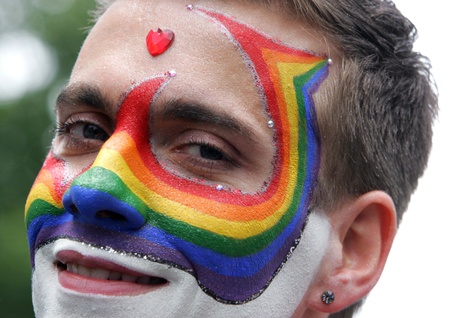
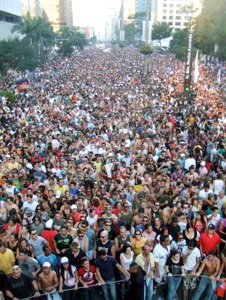
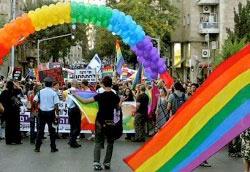
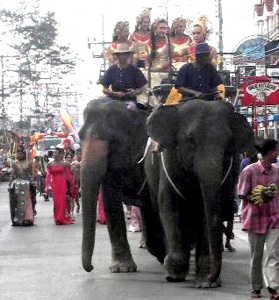
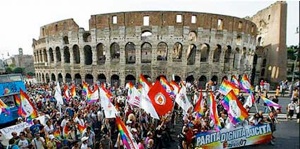
Parade crowds, clockwise from top left: Sao Paulo, Bangkok, Rome, Jerusalem.
