Veloma!
by Larry Hallock
Landing at the New Delhi airport in the middle of the night and facing the touts is like opening the door to a blizzard. Touts are the guys who dog your every step imploring you to take their taxi, their hotel, their exchange rate, their “hospitality” or whatever. I had read the warnings about the extraordinary persistence of these particular touts in the Lonely Planet guide; they’ll argue, bully and cajole—and even play dirty tricks—to move money from your pocket to theirs. I figured if I could handle touts in the Middle East, I could handle them anywhere. It turns out, however, that in the Indian languages, “no” seems to mean “yes, of course, but could you please just harass me for about an hour first?”
What’s odd is that in dealing with touts, you’re actually spending your energy saying no to ostensible hospitality. You’re standing on a corner looking at a map and a guy offers to help—prudence requires that you yell at him to go away. Or a young man strikes up a cordial conversation to practice his English with you—and then thanks you for your graciousness by offering you tea or coffee at his place. You can’t just say no—you must reinforce your answer with the only thing that works: yelling at him to leave you alone. You decline because you don’t want the police showing up with a citation for violation of “residential occupancy limits” due to your presence. Being the extra person, and therefore the cause of it, you’d have to pay the “fine.”
Is such a rude response to the touts really required? At first I didn’t think so, not even when a refined, middle-aged English woman standing next to me in line at a New Delhi bank advised otherwise. “I've lived here a long time,” she said, “so I know, you have to yell and scream at them to go away, you can’t be nice about it.” I thought I knew better. I would simply refuse to chat or argue, but just firmly say no a few times. That worked like a charm. Counter-charm.
Of course for every tout, vendor or trickster, there are countless ordinary, wonderful people, and even the touts contribute to the colorful experience travelers savor. It’s fun to tell the stories. But you have to be aware and always alert, because versions of these games are played around the world like breathing, even by children.
Youngsters in New Delhi kindly pointed out a huge bird-dropping on the toe of my shoe as I walked through a park, and cleaned it off for me—they even eagerly polished my shoe after the clean-up. American youth could learn a thing or two about courtesy from these third-world kids, I thought as I thanked and tipped them generously. I was too busy pondering how narrowly the dropping missed hitting me in the face to realize it would have taken a bird bigger than a bread-box to leave that much on my shoe. It wasn’t until later that night that it occurred to me what had actually happened….
Next day, when a new set of youngsters offered me the same assistance. I turned on them fiercely, screaming at them to clean up what they had just squirted on my shoe (by sneaking up behind me), and to polish my shoe. No tip. That caught the attention of onlookers within a block in all directions and I wondered if a mob would side with the kids and do me harm. They just looked stunned, as if they were glimpsing a great wise man or some international hero.
A train ride away, I stand in front of the Taj Mahal, camera in hand, when a friendly man approaches to clue me in on a secret…. Who could have guessed that the best place from which to shoot a picture of a symmetrical building behind a symmetrical garden with a symmetrical pool would be directly in front of it! He shows me precisely where to stand—which happens to be right where I’m standing already—and says I should point my camera directly at the building.
“Thank you,” I say, privately rolling my eyes, and out comes his hand for a reward. In America you generally have to pay somebody to put on a performance. But in some countries you’re wise to pay if you don’t want a performance. I paid nothing and got one that went something like, “You ungrateful slob!” In three acts. Plus encore.
Then there are the street vendors. No matter where you are, so are they. And of course you must bargain. I was once offered a necklace consisting of little more than a string with a piece of gravel on it for twenty U.S. dollars. I’m sure the vendor would have made a welcome profit given a nickel.
I never feel completely right bargaining for prices far lower than I’m actually willing to pay. The ambivalence over vague moral questions is always there. How do you juxtapose economies where the cost of a Coke in one country is a week’s pay in another? Sometimes I’ve benefited one vendor with a purchase, and then the next one by giving him the item I just bought from the former; it can be sold again. How can you not contribute to local economies in places like Zimbabwe, for example, where today people either starve or sell their personal effects to buy food—until they have nothing left to sell? Yet people in poor countries around the world always seem to enjoy the bargaining game as much or more than we, and they play it well.
One of my shrewdest deals occurred on a hill that leads up to the Monkey Temple (Swayambunath Stupa) on the outskirts of Kathmandu, Nepal. There I acquired a cheap beaded wire bracelet for my cousin in Kansas from a young girl who seemed to enjoy the intense dickering. The difference at stake in bargaining for such a small item is negligible, yet I still felt a tinge of guilt for paying so little.
On my way down the hill after visiting the temple, I encountered another little girl selling the same bracelets. She can pose no annoyance for me, I thought as I showed her that I had already bought one. I figured that would settle it.
“How much did you pay for it?” she persisted in asking. Why should I answer that, and make the competition tougher for someone from whom I’d extracted a rock-bottom price? Nevertheless, feeling a little smug, I proudly told her how little I had paid. She paused, then started counting bracelets on her arm. She counted to ten, pulled them off her arm and said, “Here. I’ll give you ten for that!”
So you learn.
Sort of. My favorite story is about still another young girl who also sold bracelets. It was my last day in Madagascar and I had rented a car and driver for the three-hour trip back to the airport from Berenty Lodge on the southern end of the island. Fortunately our drive was uneventful—never a given in third-world countries—so we arrived at the airport early. The terminal, a single building that looks more like a small warehouse, wasn’t yet open for its only flight of the day, so we waited in the car.
Soon a young girl appeared at the car window, bracelets in hand. Oh, this is perfect, I thought, she can’t dog my every step because I’m not steppin.’ I’m sitting inside the car writing my journal. This time I can just say no. After all, she can’t stand there with a fistful of bracelets through the window forever. Can she?
“Silver!” she begins.
My “No” drips with finality.
She begins an endless-loop sales pitch and I begin writing. Minutes go by, and she’s still there. The airport terminal is still padlocked. She continues to talk, as if I’m paying attention, and I continue to write, as if she doesn’t exist. The driver chuckles. She babbles of silver and price while I ramble of rice paddies and the iridescent shades of green that quizzically differ slightly from one adjacent patch to the next.
She rattles the bracelets and then caresses them while mumbling softly, in Malagasy mostly. I describe centuries-old baobabs and how ghoulish these “upside down” trees look with tops that resemble roots. It starts to rain lightly and the young girl gets wet, except for her hands and arms which are still through the open window. Another five minutes go by. And another. She still carries on as though I’m listening. But I’m covering the Spiny Forest, ringtail lemurs and other plants and creatures found nowhere else in the world.
“Silver,” she insists, wiping rain from her face with a shoulder. “Tamarind seeds,” I write. Women carry them down lush tropical trails, in baskets atop their heads.
The driver continues to chuckle periodically.
Then the young girl accidentally drops a bracelet, which lands in the car at my feet, beyond her reach. I pick it up and try to sell it back to her. “Silver!” I say, knowing I lie. She laughs out of character, I give it back to her and the standoff resumes.
Eventually it seems time for a compromise, so I decide to blink first. A word has come to mind from an earlier look at some Malagasy vocabulary in the guidebook, and I look it up again, just to be sure. Veloma. I mentally practice its two-syllable pronunciation: ve-LOOM!
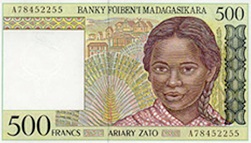
As I reach into my pocket, she seems stunned by the smell of sweet success, and I wonder how disappointed she’ll be to discover she has not made a sale after all. I pull out a paper bill, five hundred Malagasy francs—the mere equivalent of a few U.S. cents, and but a fraction of the cost of a “silver” bracelet.
For nothing in return, I hand her that pittance with an exaggerated tone of great annoyance: “Veloma!”
“Veloma,” she replies with a giggle—not as in “good-bye back,” but as in amazement that I know the word for good-bye in her language—and the perfect way to use it.
She literally jumped for joy and then literally skipped away in song, a few cents richer and no reduction of inventory.
And to think I tried not to know her….
__________________
Copyright © 2004 by Larry Hallock
“Silver!” I say, knowing I lie.